I normally like to infuse some humor into my articles. Not this one. This is something that needs real attention and employers really need to recognize it. A good friend of mine works for one of the major telco, on the cell site management side. When we get together for lunch, the conversation is usually the standard rotation vacations, kids, wives, and the boneheads at work. Our last lunch was different. He told me he believes his job will be eliminated within the next few years and that he's genuinely relieved to be close to retirement so he is not that worried. Then he said the part that stuck with me, he's afraid for his children, who are just starting their careers. That hit me, I need to write about this. So here it goes.
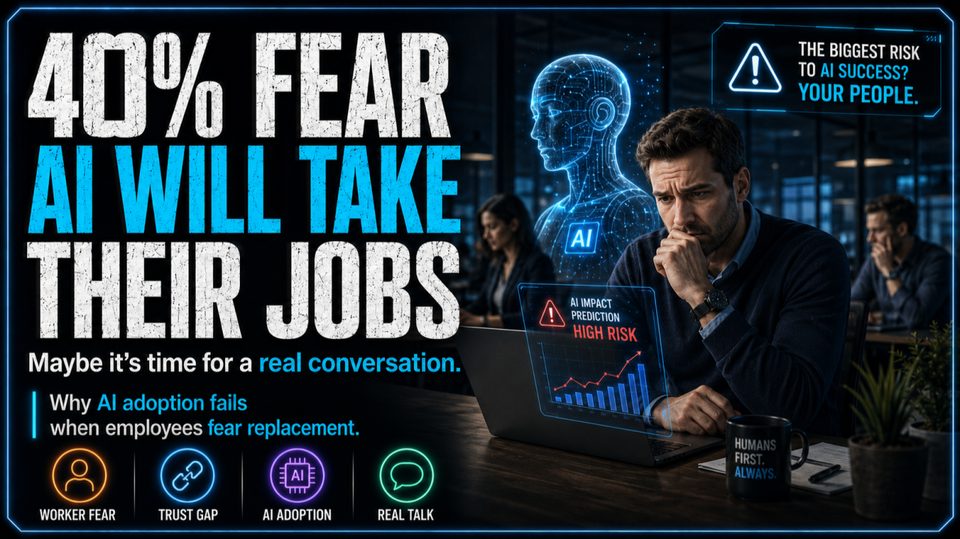
My friend is not alone. Forty percent of workers now fear losing their job to AI. That's not a fringe anxiety that's a Mercer survey of 12,000 workers worldwide, and the number is climbing fast, up from 28% just two years ago. Nearly half your workforce believes the technology you're asking them to adopt is the same technology that will eventually replace them. Now look at your AI adoption numbers and tell me the two aren't connected.
Average digital transformation budgets jumped 38% last year to $54.2 million per Enterprise the biggest technology bet most companies have ever made. And yet a global WalkMe/SAP survey of 3,750 executives and employees across 14 countries found that 54% of workers bypassed their company's AI tools in the past 30 days and did the work manually instead. Another 33% haven't touched AI at all. Roughly eight in ten enterprise workers are avoiding or actively rejecting the technology their employers are betting the company on and 40% of that record spend is underperforming because of it. Executives keep calling this a training problem, a tooling problem, a change management problem. It's none of those. It's a fear problem. And it's entirely rational.
The Fear Is Doing the Math
Companies attributed 55,000 job cuts directly to AI in 2025, a twelvefold increase from 2023, wow. Sixty-nine percent of US workers expect parts of their job to be automated within the next 24 months. Half of Americans fear AI will put someone in their own household out of work. Then their employer hands them an AI tool and says "Use this. It'll make you more efficient." Workers have done the math on what "more efficient" means. Every prompt they write, every workflow they automate, every task they hand to the machine is potentially training their replacement or proving their team can run with fewer people. So, they smile in meetings, nod through the mandatory training, and quietly go back to doing the work by hand and the data backs this up. A 2026 survey of American workers found that one in four have secretly avoided or refused AI without ever telling their manager. Forty-five percent have skipped an available AI tool and done the task manually. Fourteen percent actively talk coworkers out of using it and some research puts deliberate resistance as high as 29% of employees working against their company's rollout outright. This isn't laziness. It isn't technophobia. It's self-preservation. As one analysis of the WalkMe data put it: workers stopped using AI not because it doesn't work but because they're afraid of what happens when it works too well.
The Industry Did This to Itself
Where did the fear come from? The AI industry's own marketing. For three years the sales pitch to executives has essentially been, this technology will let you do more with fewer people. Employees heard it loud and clear because it was said loud and clear, on earnings calls and in keynotes. You can't spend billions telling workers they're obsolete and then act surprised when they refuse to train their replacement. Even the people selling AI now admit it. Microsoft CEO Satya Nadella recently conceded the industry's job loss messaging has backfired. Nvidia's Jensen Huang blasted fellow tech CEOs for the "lazy" AI-layoff narrative "I really hate that." AWS CEO Matt Garman called replacing junior employees with AI "one of the dumbest ideas" he's heard. And Palantir's Alex Karp warned his peers bluntly don't be surprised if your employees turn against you. Meanwhile, leadership remains blind to the gap. Sixty-one percent of executives trust AI for business-critical decisions. Among workers, it's 9%, and that is a 52 point spread. Eighty-eight percent of executives say their employees have adequate AI tools only 21% of workers agree.
You Can't Train Away Fear
No amount of lunch-and-learns, license purchases, or adoption dashboards will fix this, because the blocker isn't skill. It's a question every employee is silently asking the same one my friend answered over lunch, What happens to me when this works? This is the problem, isn't it...the truth hiding behind "productivity hacking" and "efficiency gains."
Three things I'd tell any leadership team.
1) Tell your people specifically what AI adoption means for their roles.
2) If you can commit that productivity gains won't become headcount cuts, say it explicitly and put it in writing. If you can't, understand that your adoption numbers will reflect it.
3) The people who embrace these tools should visibly become more valuable promoted, recognized, given bigger problems.
Right now, the reward for automating your own workflow is ambiguity at best. Flip that incentive and the resistance flips with it. Dashboards tell you what people do anonymous surveys tell you why. If 40% of your workforce fears replacement, that's the leading indicator for every AI initiative you launch this year. My friend gets to retire out of this problem. His kids don't and neither do your employees. The companies that win with AI won't be the ones that spent the most. They'll be the ones whose people decided it was safe to say yes. Right now, four in ten are afraid to. That's not a technology gap. It's a fear gap, and in closing it is a leadership deliverable not something a vendor can sell you.
Sources
Mercer global survey (12,000 workers): 40% fear job loss to AI, up from 28% in 2024; 55,000 job cuts attributed to AI in 2025 (12x vs. 2023)WalkMe/SAP State of Digital Adoption 2026 (3,750 respondents, 14 countries), via Fortune, April 2026 Omni Calculator 2026 survey (918 US workers): secret AI avoidance and manual-work pushback GCheck Automation Anxiety Report 2026: 69% expect partial automation within 24 months Reuters/Ipsos poll: household job-loss fear;Center Square poll (June 2026): 70% concerned Quotes: Satya Nadella (News18, July 2026)YoMama; Jensen Huang (Times Now, May 2026); Matt Garman (Fortune)
Originally published by Mark Putiyon on LinkedIn. Join the discussion there.
Read on LinkedInFounder of Technology Innovation Partners — 30+ years helping businesses secure and modernize their IT.