I’ve spent the past year putting AI systems into businesses that already have payroll, tickets, and angry customers at 4:47 p.m. Here’s what I believe now that I didn’t believe twelve months ago.
Belief 1: The hard part is rarely the model
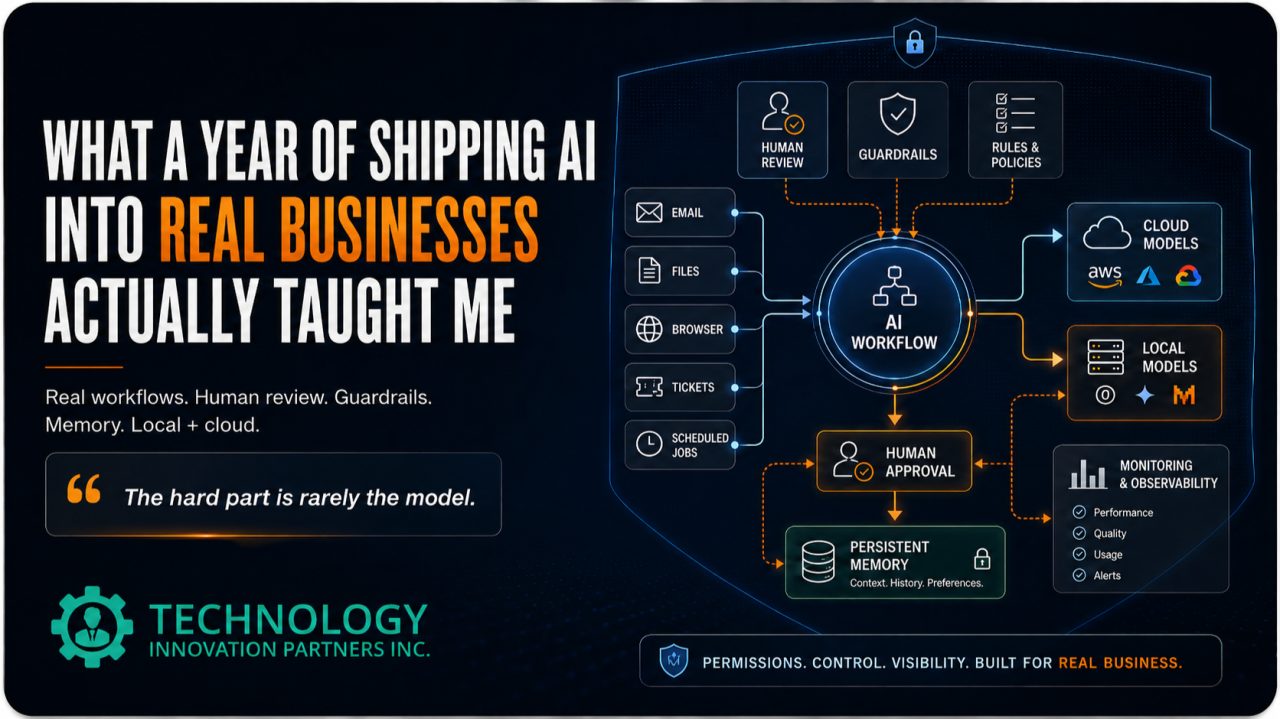
A year ago I still caught myself treating model choice like the whole project. Pick the smartest one. Wire it up. Watch the demo clap. In live use, the model is maybe twenty percent of the pain. The rest is boring: where the data lives, who can touch it, what happens when the agent is wrong, and who gets paged when it is confidently wrong at 2 a.m.. We run agents that can read mail, write files, open a browser, and kick off scheduled jobs. That is useful. It is also a brilliant intern with a company credit card. The year taught me to budget as much time for guardrails and review paths as for the “wow” moment.
Belief 2: The wrapper changes. The job does not.
I started on OpenClaw. Then I moved to Claude Code. I'm writing this with help from my little friend :) Grok Bot. Different logos. Different chats. Under the hood they are AI wrappers: a place for memory, tools, agents, and a human who still owns the mistake. Once I saw that, I stopped shopping for magic and started asking a simpler question. Which wrapper fits how we already work, and where do we put the review path? The year did not teach me loyalty to one brand. It taught me to evaluate the wrapper the same way I evaluate any other ops tool.
Belief 3: Local and cloud both win, for different work
I used to feel pressured to pick a camp. All local for control. All cloud for brains. What we actually do now is split the work. Mundane, high-volume tasks go through cheaper or local models where “very good” is enough and the data should stay put. Harder reasoning and build work still gets a frontier model when a mistake is expensive. That split is a business decision of cost, control, accuracy and risk. Same trade-offs you already make for insurance, staffing, and software licenses. The year didn’t crown a winner. It made me stop asking “which AI” like it was a religion.
Belief 4: Memory beats clever prompts
Early on I over invested in prompt poetry. In actual work, the systems that stuck were the ones that remembered context across days, plain files on disk, notes that survive a restart, routines that fire without someone re-explaining the whole job every morning. A model that forgets who you are every session is a demo with good lighting. A system that keeps state, even imperfectly, starts to feel like an operator. That was a bigger shift in my head than any single model release.
Belief 5: Supervision is part of the product
I used to treat human review as a temporary training wheel. Now I treat it as a feature. Any agent that can send mail, change a record, or run a command needs a clear line, what it may do alone, what needs a human click, and what it must never touch. Clients don’t buy “autonomous.” They buy fewer dropped balls with someone still accountable. Skip that line and the agent doesn’t make you faster. It just helps you break things with nicer wording.
What I’m still careful about sharing
I’m not going to publish our wiring diagrams, tool lists, or the exact paths we use to keep tenants apart. Competitors don’t need a checklist, and customers don’t need a roadmap to copy. What I will say, if your AI project only works in a slide deck, you don’t have a deployment problem yet. You have to be honest with yourself. Ship something small, into a real workflow. Watch where it fails and put the review path(Human) in before you scale.
One ask
If you’ve put an agent into a live business in the last year, not a pilot that never left IT, what belief of yours died first? I read all the replies.
Originally published by Mark Putiyon on LinkedIn. Join the discussion there.
Read on LinkedInFounder of Technology Innovation Partners — 30+ years helping businesses secure and modernize their IT.