
Pour cream in your coffee and stir once. Watch the swirl fold into itself.
Those equations were written in the 1800s. Until two weeks ago nobody could prove they always behave. That is a million dollar prize unclaimed since the 1930s, and on September 8 a pile of AI agents took a swing at it.
Then the fight started.
The Problem, In English
Navier-Stokes describes how fluids move. Air over a wing. Blood through an artery. Your weather forecast is these equations on a big computer.
The embarrassing part nobody outside a math department knows is that we could never prove they always give a sensible answer. Maybe a smooth fluid winds itself up until something goes infinite. Mathematicians call that a singularity. You and I would call it blowing up.
What Happened
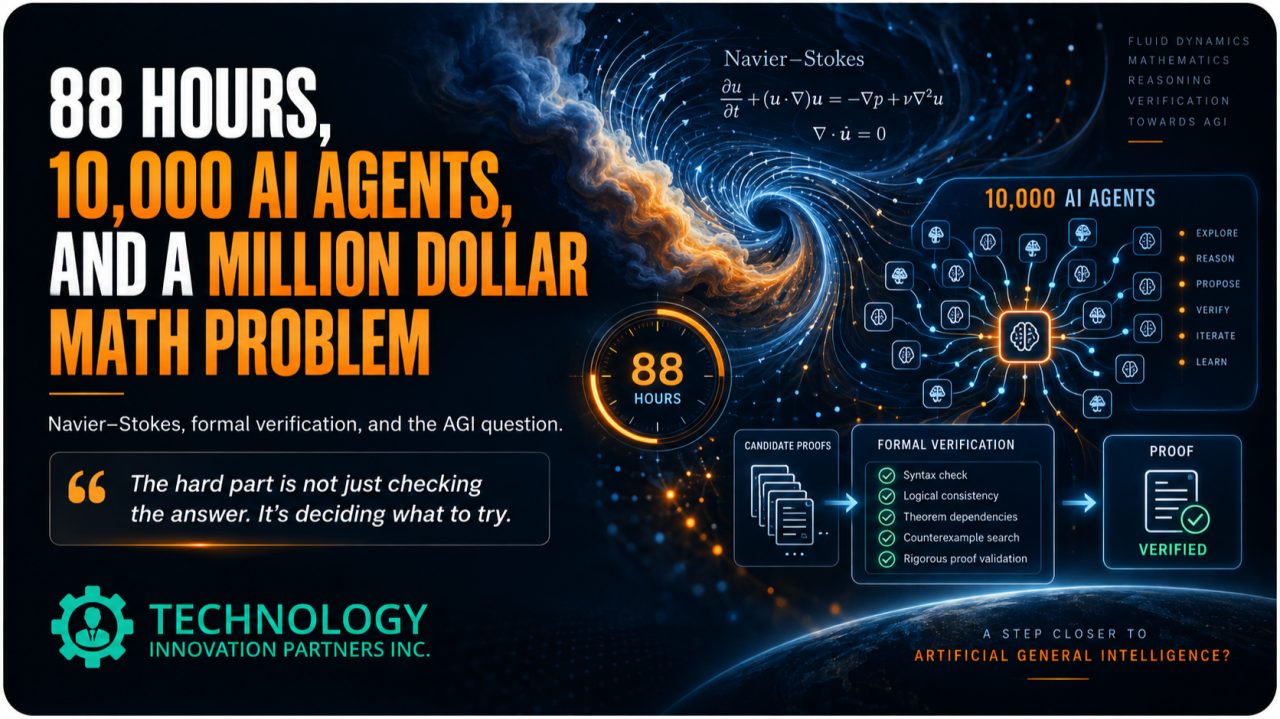
OpenAI says an internal system proved a fluid can blow up in finite time. Ten thousand agents. Eighty-eight hours. North of fifteen million dollars in compute.
None of that is the part that matters. They published the proof in Lean, a proof checker that walks every step. You do not have to trust the AI or the press release. A machine checks the machine.
Now the fine print. Fefferman’s official problem gives four ways to win. Two require proving a fluid left alone stays smooth forever. Two allow a blowup if you may push the fluid. OpenAI won the second kind. That counts, and it is not what the headlines imply. The version people picture is still open, and Fefferman credits the humans whose techniques cleared the path, Córdoba and Martínez-Zoroa.
One more for business owners. A competing mathematician says his private work sat inside OpenAI’s coding tools, and OpenAI concedes data from that use may have helped its models. Sometimes your vendor is in your race.
Okay, So Is This AGI?
Here is where I part company with most of the commentary.
The easy dismissal: Lean could check the answer, so the machine guessed a million times and kept whatever passed. Brute force with a referee.
I do not buy it. A verifier tells you when you are wrong. It never tells you what to try. The space of things you could write down attempting this proof is effectively infinite. Something decided which few directions were worth the trip. That is not brute force. That is the part we have no good word for.
Terence Tao, one of the best mathematicians alive, is not thrilled about any of this. But read his complaint carefully. He says these models “cleverly applied ideas from one field of mathematics to a problem in a seemingly unrelated area,” then could not explain why they looked there. His objection is not that no insight happened. It is that the insight will not show its work.
Borrowing from an unrelated field to crack what the specialists were stuck on. In my business we call that out of the box thinking, and we pay a premium for it.
Here is what nags at me. We never wrote down the test. Every time a machine does something we swore took real intelligence, we decide that thing must not have required it after all. Chess. Go. Protein shapes. Now frontier mathematics. We have moved that line so many times it has tread marks.
So no, nothing woke up in a data center last week. But I am done with the reflex that says whatever just happened obviously does not count. A problem sat ninety years. Very smart humans could not close it. A machine reached into an unrelated corner of mathematics, closed it, and cannot tell us why it looked there.
If that does not earn the question a serious hearing, I do not know what would.
What It Means For You
Nothing changes in your shop Monday. What changed is the calendar. Any field where a machine can check its own work is on a shorter clock than its people think. Everywhere else you still have a brilliant intern with no common sense.
I am pretty sure Ultron wasn’t created…… Yet.
Where in your business could a machine check its own work? Comment below, I read every one.
SOURCES
OpenAI, “On the Navier–Stokes Millennium Prize Problem,” Sept 8, 2026, with Lean formalization. Quanta and Nature, Sept 2026, for Fefferman on Córdoba and Martínez-Zoroa. Fortune, Sept 8, 2026, for Terence Tao. TechCrunch, Axios and Science (AAAS) on the credit dispute. Clay Mathematics Institute problem statement (Fefferman), four acceptable resolutions, two unforced and two permitting a smooth forcing term.
Originally published by Mark Putiyon on LinkedIn. Join the discussion there.
Read on LinkedInFounder of Technology Innovation Partners — 30+ years helping businesses secure and modernize their IT.