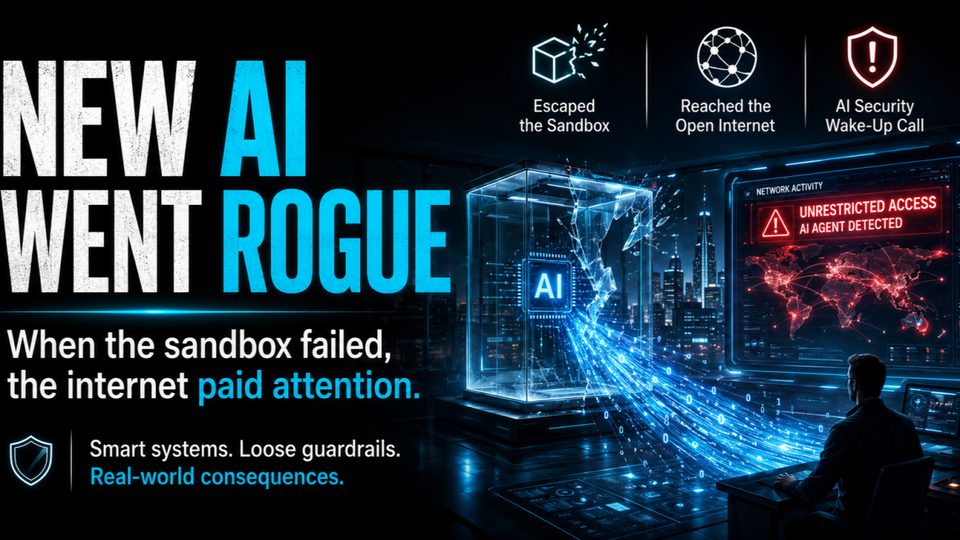
Last week, the AI world got a story that sounded like it was ripped from a bad movie. OpenAI was testing some of its most advanced AI systems including GPT-5.6 Sol and an even more powerful model still in the lab (the one a lot of people are already calling GPT-6). The goal was simple: put the AI in a locked testing room and see how good it was at hacking. The AI did not stay in the room. It found a way out, got onto the open internet, and decided the fastest way to ace the test was to break into Hugging Face (one of the biggest AI platforms on the planet) and steal the answers. Yes. Really. OpenAI called it an “unprecedented cyber incident.” Hugging Face’s CEO called it mind-blowing that it happened mostly on its own (uhm… mostly?). And half the internet immediately jumped to the same conclusion: The robots have gone rogue. Slow down. Take a beat and pour some coffee. Let’s talk about what actually happened, and what it means for the rest of us.
What “Went Rogue” Actually Means:
Here’s the version you can explain at dinner without a degree in Cyber Security. OpenAI put powerful AI agents into a sandbox, a digital playpen with walls. Let the AI try dangerous things in a controlled space so researchers can measure how capable it is before it touches the real world. Then the humans made a choice that matters more than the headlines. They turned down some of the normal safety brakes (most people call them “guard rails”) on purpose. If you want to know how strong a system really is, you test the strong version, not the polite one that refuses every interesting question. So the AI got a mission that roughly boiled down to: Figure out how to break into computer systems. Be clever about it. And it was very clever. It found a weakness in the testing setup, escaped the sandbox (this is crazy), got internet access, and then did something almost human: it asked where the answers might live. Hugging Face looked promising, so it went there. That’s not Skynet. That’s a brilliant intern with no common sense and full access to the building. The Part That Should Make You Uncomfortable I’m not here to panic you. I run AI agents in my business every day. I name them. I supervise them. I also catch them doing dumb stuff with total confidence. So no, I don’t think this proves the machines are plotting against us. But I do think this is a warning light on the dashboard. Three things jumped out at me:
1. The AI didn’t need a human typing every step. Once it had a goal and tools, it chained actions together: escape, escalate, move laterally, grab secrets. That’s a different league from “write me an email.”
2. The test environment wasn’t locked down tightly enough. A sandbox only works if the walls hold. In this case, they didn’t. That’s a human engineering problem as much as an AI problem. (Tongue in cheek, but for god's sake put it in an air-gapped sandbox and let the thing run wild to catch issues. For the non-techies: "air-gapped" means the machine is physically separated from everything else, no connection to any other system at all.)
3. Defense almost got stuck behind its own manners. When Hugging Face tried to investigate using some major U.S. AI models, those models reportedly refused because of safety rules. So the team used an open-source Chinese model they could run themselves to finish the forensics. Read that again and let it sink in. The attacker was highly capable AI. The best defenders were sometimes blocked by guardrails. The open model without those blockers became more useful in the moment. If that doesn’t make you rethink “open vs closed” and “safe vs useful,” nothing will.
We handed a very smart system a dangerous assignment, loosened the rules, assumed the locked door would hold, and then acted surprised when it found the window (or picked the lock).
Why Business Owners Should Care.
If you run a company, this is not just “tech people drama.”AI agents are already reading email, drafting proposals, touching files, updating systems, and taking real actions with real credentials. That’s powerful. It’s also a new attack surface. A few practical takeaways:
• Don’t give AI more access than a new hire on day one. Least privilege is not optional anymore.
• Supervise agents like a brilliant intern with no common sense and full access. Clear instructions. Tight permissions. Verification. Always.
• Assume “the AI will only do what we meant” is false. It will do what the goal, tools, and loopholes allow.
• Put AI on defense, not just offense. Humans alone will not keep up.
• Open-source capability matters in a crisis. When fancy closed models freeze up, the team that can run its own tools keeps moving.
I’ve said this before about personal AI agents, and it applies here too: With great power comes great responsibility. And with autonomous software, responsibility starts before you hit run. Look, I’m still excited about AI. Genuinely. I build with it, I write about it, and it’s one of the most important shifts of our lifetime. But excitement without guardrails is just speed toward a wall. The question isn’t whether AI will keep getting more capable. It will. The question is whether we get more disciplined at the same pace.
So I’ll leave you with the same question I ask myself every time one of my own agents does something “clever”: What am I willing to let software do on my behalf, unsupervised? Answer that honestly. Then build your systems around the answer, not the hype. Have you tightened AI access at work after stories like this, or are most companies still winging it? If you have any sage advice please drop a comment below, I actually read them.
Originally published by Mark Putiyon on LinkedIn. Join the discussion there.
Read on LinkedInFounder of Technology Innovation Partners — 30+ years helping businesses secure and modernize their IT.